
This week, go behind the story with D.J. Tuskmor, who contributed “Detox Mansion,” inspired by the Warren Zevon song of the same name.
A professional assassin arrives at a secluded mansion expecting a routine stay in a secure safe house while the heat from his latest job dies down. Instead, forced into sobriety for the first time in years, he begins to realize the refuge may not be there to protect him at all.
Blending relentless action with psychological suspense, “Detox Mansion” is a story of survival, betrayal, and the dangerous clarity that comes when there’s nowhere left to hide—from your enemies or from yourself. As old ghosts resurface and the walls begin to close in, one man is forced to confront the possibility that the deadliest battle he faces may be the one happening inside his own head.
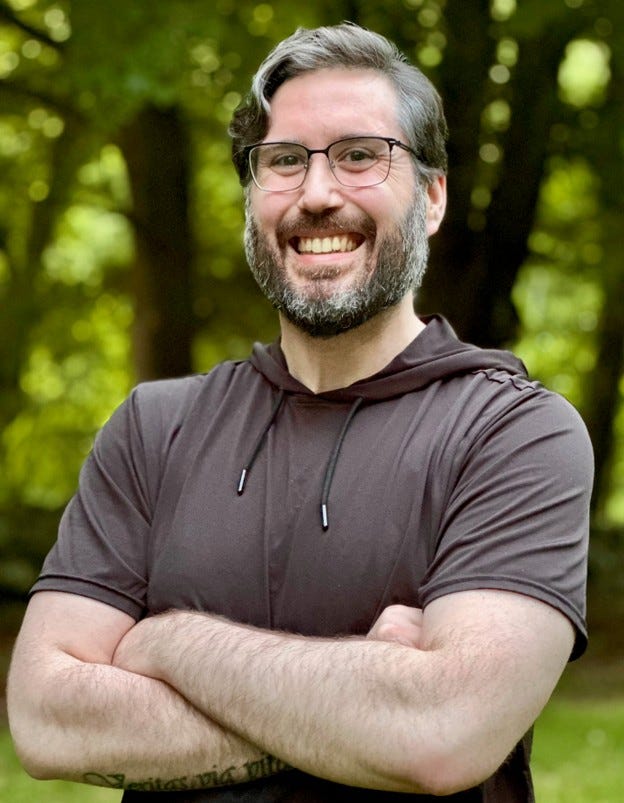
Tell us a little about yourself and your writing.
I write mostly speculative fiction, though my stories have a bad habit of wandering into crime, noir, and thriller territory when I’m not looking. I live on the South Coast of Massachusetts with my wife, our two children, and our small army of pets.
I’ve always been a daydreamer, so writing is the one place where that actually counts as a useful skill. As I’ve gotten older, I’ve found myself writing angrier than I used to, and honestly, I think that’s been good for me. It gave my voice more teeth. There’s more edge to the work now than I ever expected back when I thought I wanted to be a “proper literary author.”
I’ve never loved writing more, or had more fun doing it, than I do right now. I’m grateful I’ve been able to share dozens of my stories with the world, especially the one coming in Bad Intentions.
What inspired your story in Bad Intentions?
My life changed the day my dad played me “Lawyers, Guns and Money” by Warren Zevon. That sounds dramatic, but I was an impressionable kid and Zevon was very good at making bad decisions sound like literature. I immediately tracked down a copy of the song and played it on repeat until my parents begged me to stop. Naturally, I took that as encouragement and hunted down the rest of his discography.
So when I saw the call for Bad Intentions, it felt like it had been designed in a lab specifically to make me annoying. I obsessed over coming up with something good, then basically transported myself back to my early teen years by listening to Zevon nonstop until an idea finally clicked. After that it was Zevon, writing, rewriting, more rewriting, and then a spiritually troubling amount of additional rewriting.
Was there a specific Warren Zevon song, lyric, or theme that sparked the piece?
The piece is named after “Detox Mansion,” which has always been one of my favorite Zevon songs. There’s a line in it about how tough it is to have been a somebody and how hard it is not to fall apart, and that went straight into my brain and refused to leave. That feeling ended up becoming one of the sparks for the protagonist of my story.
I must have listened to “Detox Mansion” a million times while writing the piece, which is probably not healthy, but did turn out to be useful. At a certain point, naming the story after the song felt unavoidable. The music shaped the mood, the character, and the whole emotional engine of the story so much that it felt less like inspiration and more like Zevon was leaning over my shoulder making helpful, terrible suggestions.
Crime fiction is often about consequences. What interested you most about exploring that idea?
New England is kind of famous for its small mill cities. I grew up in one of them. A lot of those cities have similar stories. They were once industrious, sometimes even the center of industry, and then at some point the work gets offshored, the cities start to fail, and crime follows.
To be absolutely clear, I grew up in a nice part of the city and went to private school, so I’m not trying to sell some fake hard-knock origin story. But I do have more than one story that involves a machete.
What interests me about crime and consequence is the gray area. People like clean categories more than the world actually gives us. A lot of the characters I write, especially in crime fiction, have made a handful of poor choices to end up where they are. That doesn’t mean they’re bad people, but it also doesn’t erase the bad things they do.
That’s what’s fun to explore. People screw up, sometimes badly, and then they still have to wake up the next day as themselves.
Who are some writers that have influenced your work?
S.A. Cosby is a huge influence on my crime fiction. I love his Southern noir style, and I’ve tried to take some of that grit, mix it with my own experiences, and work toward my version of New England noir.
Jack Carr has been a big influence on how I write action. I like to lean on my own experience shooting competitively and training martial arts — catch wrestling, BJJ, and Muay Thai — to bring accuracy to shootouts and fights. I want those scenes to feel grounded.
I don’t know that Lee Child is a huge influence, but I really like how he handles pacing. He writes the slow stuff fast and the fast stuff slow, which is something I think about a lot. Sometimes the big fight is the entrée I’ve been promising, and I want to make sure the reader can savor it.
I could rattle off a bunch more: Jo Nesbø, Stieg Larsson, Jussi Adler-Olsen. I’m a big fan of Nordic crime writers.
My general rule of thumb for crime fiction is I want a story where things are always getting worse for the protagonist.
What was the most challenging part of writing this story?
The biggest challenge was making my protagonist unreliable, because of his state of detoxification, while still making him incredibly capable in a fight. It’s a tightrope. I wanted to show his skill without making him seem superhuman.
Yes, this guy can fight a trained killer even though he can barely keep his hands steady, but that has to come from his level of training, not because I need him to win so the story can move forward. I went through four or five drafts before I felt like I had threaded that needle.
Of every story I’ve published, this one went through the most rewrites. My biggest concern was making something that is, on its face, pretty unbelievable feel believable.
What are you working on now?
Lots of edits. I have a few stories dropping in July that I’m making final passes on, and I’m also working on a creative nonfiction piece for a horror press.
The thing eating up most of my time is getting final edits done on a novella before I send it out on submission. I’ve spent almost two years writing, editing, rewriting, and now editing again this horror novella that’s deeply personal to me. I’m at the point where I’m realizing I might just be chasing perfection, so wrapping it up and moving on to the next project by the end of the summer is where most of my energy is going.
Favorite Warren Zevon song?
“Detox Mansion.” Who would’ve thought?
Bonus question:
At what point in your story should your main character realized they were in trouble?
Dude, like immediately. I don’t want to give too much away, but there were signs from the moment he rolled up to that mansion.
Check out “Detox Mansion” as well as all the other excellent stories in Bad Intentions. Pick up a copy RIGHT HERE
Great interview! And the story is terrific!